
Most reviews of past decisions are backward-looking catalogues of blame or boilerplate lessons no one reads. A decision autopsy is neither. It is a structured comparison of what was assumed before the decision was made and what actually occurred, using the same method the decision should have used in the first place.
The purpose is not to assign fault. It is to understand which assumptions held, which broke, and whether the decision-maker had sufficient certainty at the time. [TODO: sharpen opening, connect to the Universal Decision-Making Method explicitly.]
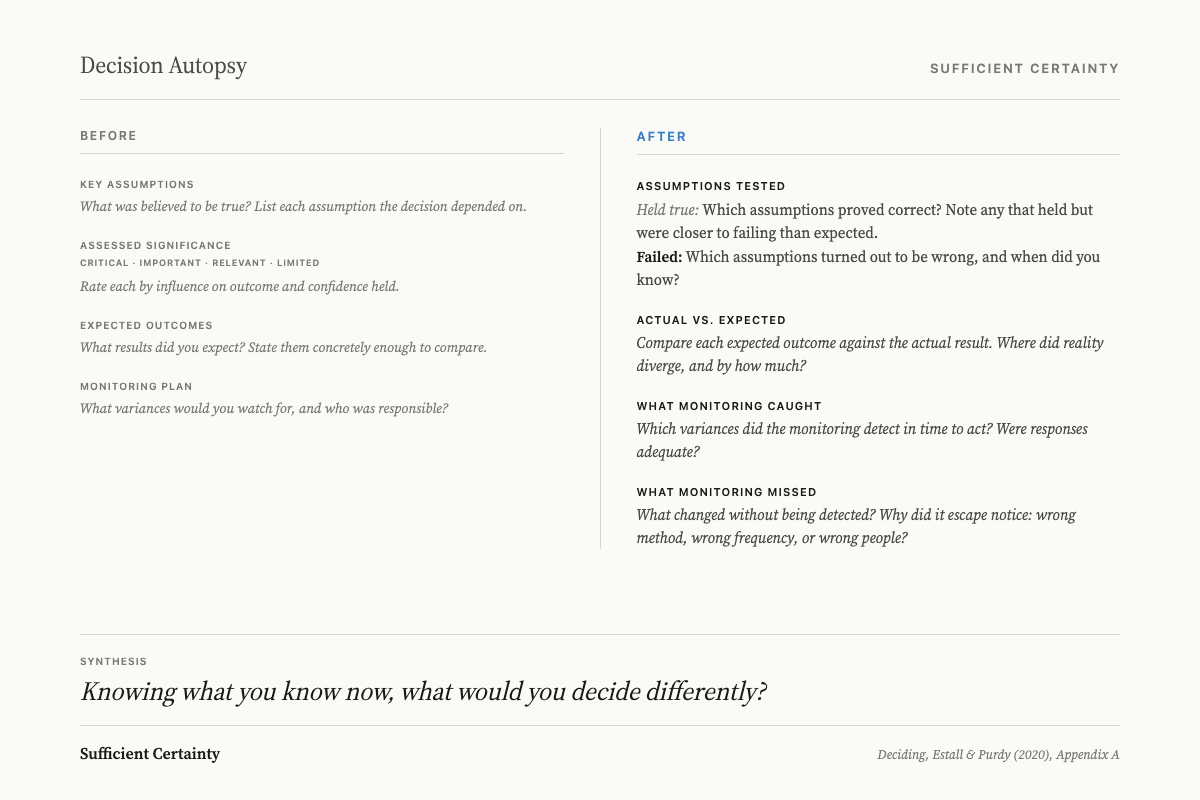
What the autopsy examines
The autopsy places two snapshots side by side: the state of knowledge before the decision, and the state of knowledge now. Purpose, tentative decision, assumptions, significance ratings, monitoring conditions. Each element is compared. [TODO: expand with specific before/after structure from the method.]
The value is in the gap between the two columns. Where assumptions were wrong, the question is whether the decision-maker could have known. Where assumptions held, the question is whether that was skill or luck. [TODO: add example.]
How to run one
Revisit the original Decision Record. If none exists, reconstruct what was assumed at the time. State each assumption and its original significance rating. Then record what actually happened. [TODO: detail the step-by-step process, reference Chapter X of Deciding.]
The conversation matters more than the document. The autopsy works best when the original Decider is in the room and willing to examine their own reasoning honestly. [TODO: add practical guidance on facilitation.]
When an autopsy is worth the effort
Not every decision warrants one. An autopsy is worth the effort when a decision produced outcomes significantly different from what was intended, or when the decision was important enough that understanding its assumptions will improve future decisions of the same kind. [TODO: add criteria, examples of when to skip.]
The point is not to relitigate. It is to sharpen the next decision by understanding this one. [TODO: closing thought connecting back to sufficient certainty.]
Grant Purdy is the co-author, with Roger Estall, of Deciding (2020), and the architect of the Universal Decision-Making Method.
If you have a decision you are working through, the Walk can help.
Start a Walk